Every Time You Wear Something You Hate, You're Paying a Price Nobody Talks About

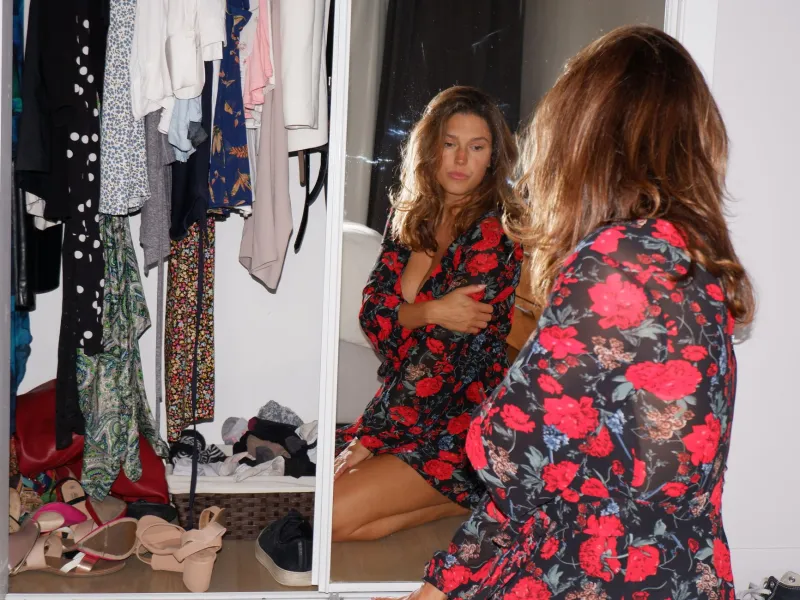
You know the feeling. You're standing in front of your closet at 7:45 a.m., running five minutes late, and somehow you still end up reaching for that top. The one that's fine. The one that technically fits. The one you bought on sale because it seemed responsible at the time. You put it on, glance in the mirror, feel vaguely deflated, and walk out the door anyway.
That interaction — the hesitation, the settling, the low-grade dissatisfaction that follows you into your morning — has a name. Call it the confidence tax. And like most taxes, it's quietly bleeding you dry.
What the Confidence Tax Actually Is
The confidence tax isn't a number on a receipt. It's the cumulative cost of wearing clothes that don't fully work for you — pieces you're unsure about, pieces you bought hoping they'd grow on you, pieces you keep because getting rid of them feels wasteful. The cost shows up in three distinct ways: mentally, emotionally, and financially. And most people are paying all three simultaneously without realizing it.
Let's start with the mental side, because it's the one we talk about least.
Every morning you spend time deliberating between items in your closet, your brain is burning through a finite resource: decision-making energy. Researchers call this phenomenon decision fatigue, and it's well-documented in behavioral psychology. The more low-stakes decisions you make early in the day — including agonizing over whether the beige trousers are really working — the less mental clarity you have for the decisions that actually matter. Your 9 a.m. presentation. That tough email you need to draft. The negotiation you've been preparing for.
Steve Jobs wore the same thing every day for a reason. So did Barack Obama. Neither of them were making a fashion statement — they were protecting cognitive bandwidth. You don't have to go full uniform, but the principle holds: a closet full of question marks is a closet that's quietly taxing your brain before your day even starts.
The Emotional Ledger Nobody Keeps
Here's where it gets more personal. Clothing isn't neutral. Science has confirmed what stylists have always known: what you wear directly influences how you feel about yourself and how you perform in the world. A 2012 study from Northwestern University coined the term "enclothed cognition" to describe the psychological changes people experience when they wear certain clothes. In plain English — your outfit is actively shaping your internal state.
When you wear something you feel genuinely great in, you move differently. You make more eye contact. You speak up in meetings. You take up space without apologizing for it. When you wear something you're uncertain about, the opposite happens. You tug at the hem. You cross your arms. You spend mental energy monitoring how you look instead of focusing on what you're doing.
That's not vanity — that's neuroscience. And it means every time you leave the house in something that makes you feel like a "maybe," you're showing up at a fraction of your actual capacity.
Over time, this compounds. Repeated experiences of feeling "off" in your clothes gradually chip away at your baseline confidence. You start to associate getting dressed with stress instead of self-expression. Your relationship with your wardrobe becomes adversarial. And that's when people start saying things like "I have nothing to wear" while standing in front of a closet stuffed with options — because technically, they're right. They have nothing they feel good in.
The Financial Illusion of the "Maybe Someday" Piece
Now let's talk money, because this is where the confidence tax gets genuinely expensive.
That $80 blouse you bought eighteen months ago and have worn twice? It's not sitting in your closet for free. Every time it takes up space — physical and mental — it's crowding out pieces you actually love and wear. It's making your closet harder to navigate. It's contributing to the overwhelm that leads you to stress-shop for something new, something that might finally feel right. And ironically, that cycle often ends with another "maybe someday" piece entering the rotation.
Behavioral economists call this the sunk cost fallacy: the irrational tendency to keep investing in something — time, space, emotional energy — because of what you've already spent on it. The $80 is gone whether the blouse is in your closet or out of it. But the cost of keeping it is ongoing.
There's also opportunity cost to consider. Every morning you spend eight minutes debating whether to wear the uncertain piece is eight minutes you didn't spend feeling confident, prepared, or calm. Multiply that across a year and you've lost hours — actual hours — to clothes that were never really serving you.
How to Audit for the Tax
The good news? The confidence tax is entirely optional once you see it clearly. Here's a simple way to identify which pieces in your closet are charging you:
The Hesitation Test. When you reach for something, notice your gut reaction before your brain kicks in. Immediate ease and excitement? That piece is earning its keep. A flicker of doubt or a mental "well, I guess"? That's a taxable item.
The Last-Worn Log. Pull everything out of your closet that you haven't worn in the last 90 days. For each piece, ask yourself honestly: Is this unworn because I haven't had the occasion, or because I keep skipping it when the occasion arises? The second category is costing you.
The Confidence Replay. Think back to the last three times you felt genuinely sharp — put-together, confident, like yourself. What were you wearing? Those items are your data points. Build toward more of them, not more of everything else.
Spending Less on the Right Things vs. More on the Wrong Ones
Here's the reframe that changes everything: a wardrobe of forty pieces you love is dramatically more valuable than a wardrobe of a hundred pieces you tolerate. Not just emotionally — financially. When you stop buying things speculatively (it's on sale, it might work, I could style it eventually), you start buying things intentionally. And intentional purchases have a radically better cost-per-wear ratio.
A $150 blazer you wear twice a week for two years costs you about $0.72 per wear. A $45 top you bought on impulse and wore three times before losing confidence in it costs you $15 per wear. The math isn't subtle.
The goal isn't a minimalist capsule wardrobe or a maximalist fantasy closet. The goal is a closet where everything you own is something you'd genuinely reach for — where getting dressed in the morning feels like choosing from a lineup of good options instead of navigating a field of compromises.
The Bottom Line
Style confidence isn't about having more clothes, more money, or more time. It's about eliminating the friction between you and feeling good. Every piece in your wardrobe is either adding to your sense of self or quietly subtracting from it. The ones doing the subtracting? They're not neutral. They're actively costing you — in energy, in mood, in money you'll eventually spend replacing the confidence they eroded.
Stop paying the tax. Your closet — and your mornings — will thank you.